
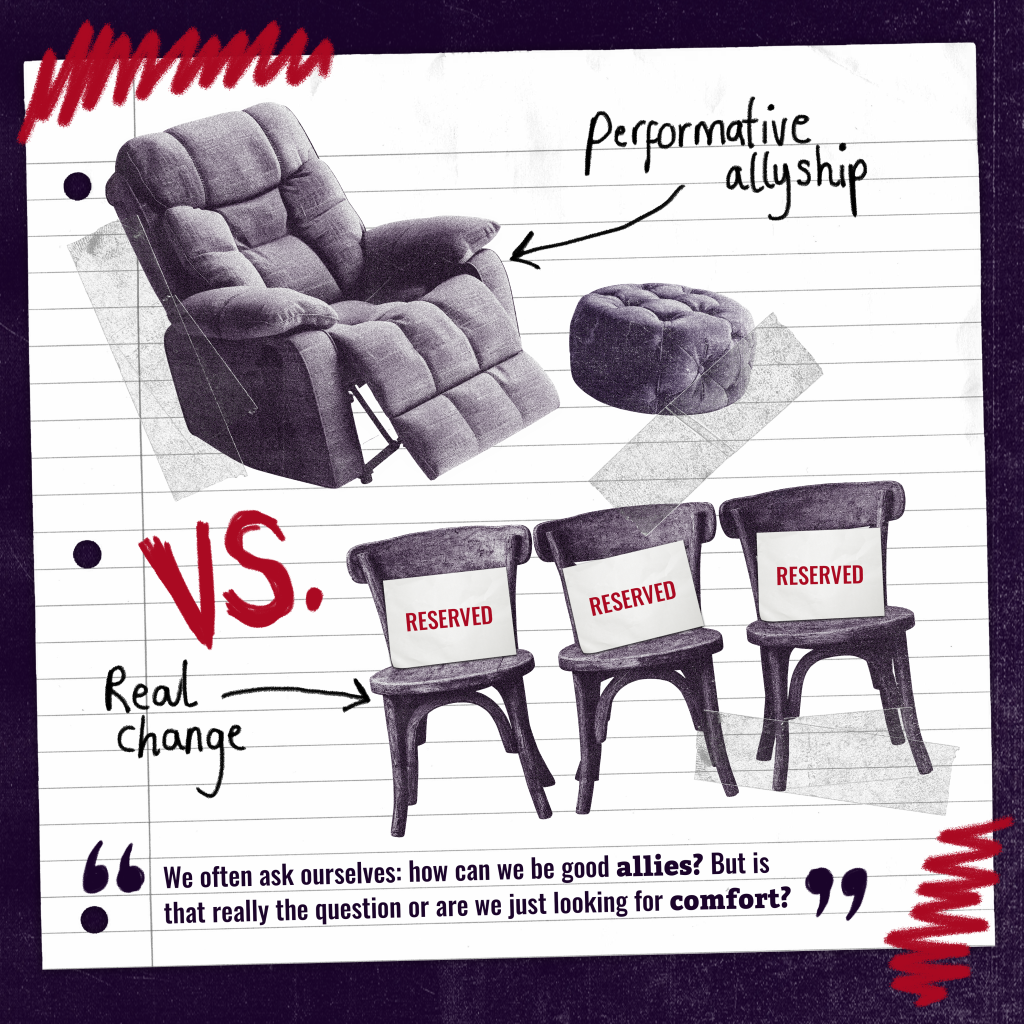
When you ask, “How can I be a good ally?”Are you truly seeking real change or just comfort? Are you willing to support the young people in your classroom by actively giving up some control to create meaningful change?
Performative Allyship
Following the murder of George Floyd in May 2020, and the subsequent Black Lives Matter protests, a flurry of Equality, Diversity and Inclusion policies were updated to include a commitment to ‘allyship’. Corporations, workplaces, and institutions needed to quickly show support for the movement and maintain social legitimacy.
In August 2020, we asked people to reflect on performative allyship using James Baldwin’s words: “I can’t believe what you say because I see what you do.” (Baldwin, 1966)
Allyship quickly became a badge to wear—a declaration that offers comfort without real sacrifice. It’s merely performative, a surface-level act that doesn’t challenge systems but instead props them up.
Are we seeking comfort?
The concept of allyship is alluring as it offers moral righteousness without requiring real accountability. Like any sliding scale, the purpose of categorising differences—like labelling Trump or others as “more racist”—is to create distance between ourselves and the problem.
But who really benefits from this? The answer is simple: you.
Allyship provides comfort in saying, “At least I’m not as bad as X,” which is closely related to the “I have a Black friend” defence. This positioning allows us to feel morally superior, without confronting our own privilege or the need for real accountability.
Declaring ourselves ‘allies’ without meaningful action keeps us complicit in the very systems we claim to challenge. It’s not too far removed from cries of “not all men”—a way to avoid responsibility rather than confront it.
Multiple points of view
We call on three thinkers to push this critique further.
- Audre Lorde reminds us, “There is no such thing as a single-issue struggle because we do not lead single-issue lives.” Therefore, allyship can’t be limited to one issue, because systems of oppression intersect, and so must our responses. . Instead of asking how to be a good ally, we should be asking: How am I unintentionally upholding the very systems I want to challenge?
- Fannie Lou Hamer said, “Nobody’s free until everybody’s free.” If we understand this sentiment, we must also recognise the multiple ways we are both victim and perpetrator. Reflecting on our role as perpetrators allows us to continually fight for collective freedom, rather than simply being an ally to someone else’s freedom. Ask yourself: ” how can I shift from allyship to true collective liberation?”
- Beverly Daniel Tatum “The task of resisting our own oppression does not relieve us of the responsibility of acknowledging the complicity in the oppression of others. It’s a reminder that allyship is not just about resisting our own challenges but also actively engaging in the dismantling of systems that harm others.
- Albert Memmi wrote, “The benevolent colonizer can never attain the good, for [their] only choice is not between good and evil, but between evil and uneasiness.” There is no grey area here. We are either evil or uncomfortable. So is it the uncomfortable choice to ask: “How can I be a good ally? – the simple answer is no!
If the option of being “good” is not available to us, perhaps teachers could ask a better question like: How am I upholding inequity in my classroom? And am I willing to sit with that discomfort and take bold action to challenge it?
About Class 13
Class 13’s mission is to put equity and relationships at the heart of education. Our work focuses on three key, interlinked challenges in education: the deterioration of young people’s mental health; rising exclusion rates that disproportionately affect “disadvantaged” and minoritised young people; and teacher retention in rapid decline.


